
Human-Computer Interaction and UX Master’s Abroad in 2027: Portfolio or Coding?
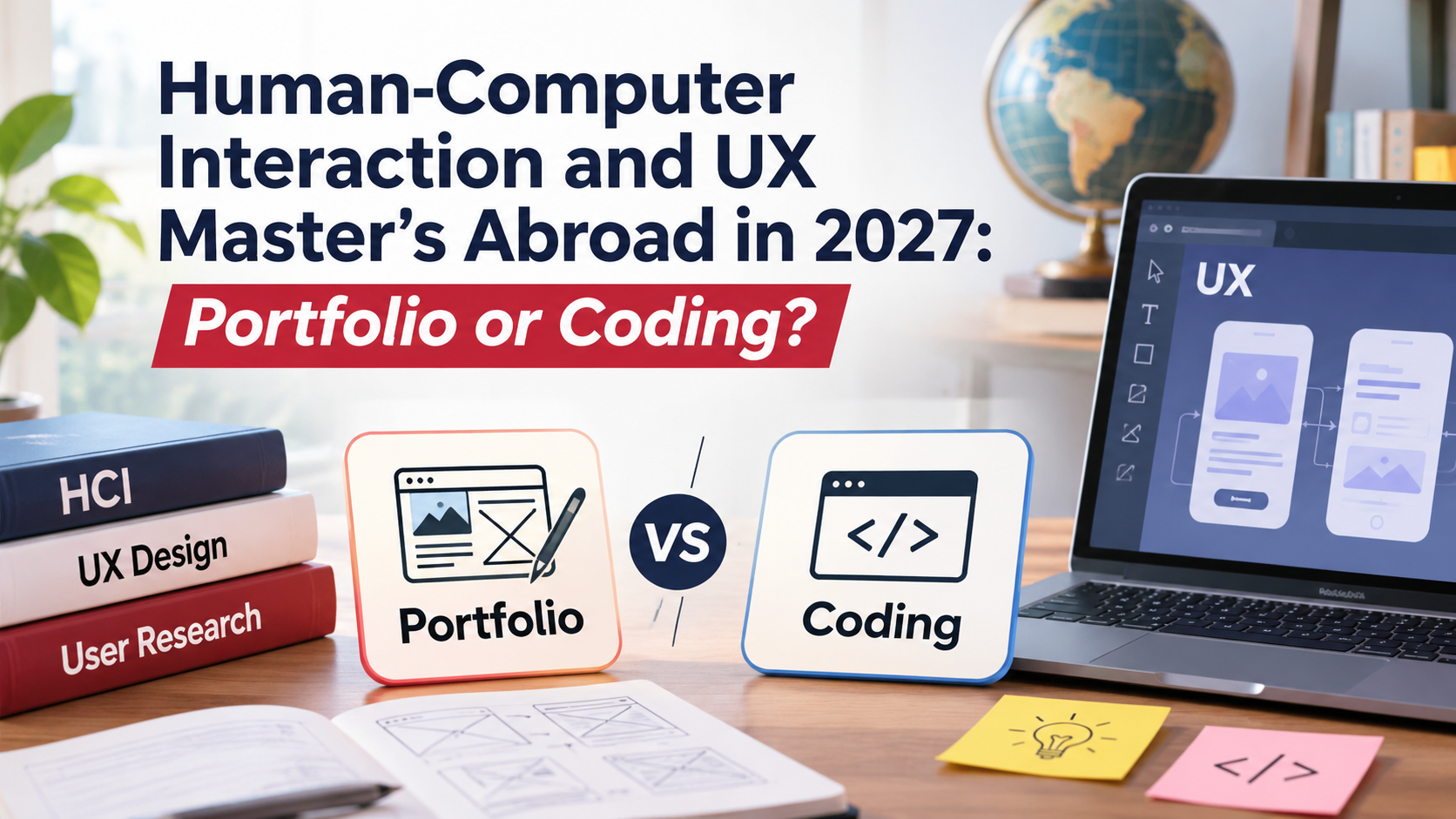
Choosing between a design portfolio and programming skills for HCI and UX masters abroad in 2027 depends entirely on the university department hosting the degree. Design-led UX programmes usually require a strong portfolio and expect little or no coding. By contrast, computer-science-housed HCI programmes prioritise technical or research rigour, often making portfolios optional while requiring basic programming readiness. Checking the exact programme model before applying saves both time and money.
Many Indian students applying for Human-Computer Interaction (HCI) and User Experience (UX) degrees feel caught between two worlds. Engineering and computer science graduates worry they lack glossy Figma case studies. Meanwhile, design, psychology, and arts graduates fear that weak coding skills will trigger instant rejections.
In reality, admissions committees do not expect every applicant to be a senior product designer and a software engineer at the same time. Instead, international universities split HCI and UX master’s degrees into distinct academic tracks. Once you understand which track matches your background, your preparation becomes much simpler.
Why “HCI and UX Master’s” Means Three Different Degrees
Before building a portfolio or taking coding bootcamps, look closely at which faculty awards the degree. Two programmes with almost identical names can evaluate applicants in completely opposite ways.
Design and Studio UX Programmes (MA, MDes, MFA): Hosted inside design or art schools, these degrees focus on visual craft, interaction prototypes, user journeys, and product aesthetics. Here, your portfolio is the most decisive part of the application, whereas coding is rarely required.
Interdisciplinary HCI Programmes (MHCI, MS-HCI, MSc HCI): These degrees sit at the meeting point of behavioural science, design, and engineering. Universities actively build mixed cohorts containing designers, psychologists, business graduates, and engineers. Depending on the university, a portfolio may be mandatory or optional, and programming may be taught through a pre-term bridge course.
Computing-Led Technical HCI Programmes (MSc in Informatics or CS-Housed HCI): Common across mainland Europe and select technical universities, these degrees evaluate your transcript strictly by academic credits. Strong software engineering, informatics, or cognitive science credits matter far more than visual design case studies.
Portfolio vs Coding: How Top Universities Actually Assess You
Looking at verified admission criteria for the 2027 cycle shows why generic advice fails so many Indian applicants. The comparison table below highlights four real institutions with very different expectations, verified on 26 November 2026.
| University & Programme | Portfolio Rule | Coding / Technical Rule | Key Note for Indian Applicants |
| Carnegie Mellon University (USA) — MHCI | Work samples optional | No strong coding background needed to apply; non-technical admits complete a pre-fall programming requirement | Requires a 4-year bachelor’s degree or equivalent; welcomes design, psychology, business, and CS graduates |
| UC Santa Cruz (USA) — MS in HCI | Mandatory online portfolio (projects need not be strictly HCI/UX) | No prior HCI experience or programming background required | Fall 2027 deadline is 3 Feb 2027; 3-year Indian degrees (BA, BSc, BCom, BBA, BCA) require an added PGD, PGDM, or Master’s |
| University College London (UK) — MSc HCI | Focuses on academic background, personal statement, and relevant experience | Suited to psychology, computer science, or closely related graduates | Combines engineering, behavioural sciences, and design across modules such as Interaction Design and Human-AI Interaction |
| Umeå University (Sweden) — MSc HCI & UX | Transcript and subject credits decide formal eligibility | Requires 90 ECTS in informatics, computer science, information systems, cognitive science, or equivalent | Autumn 2027 international deadline is 15 Jan 2027; a related degree title alone does not replace exact subject credits |
Verification note: Requirements reflect official programme policies checked on 26 November 2026. Because universities periodically adjust deadlines and equivalency policies, always reconfirm current rules directly on the programme page before submitting.
When a UX Portfolio Matters Most
If you are targeting design-led or applied UX master’s programmes, your portfolio carries more weight than test scores. Admissions reviewers do not judge you solely on pretty screens or polished colours. Instead, they want to see how you think through a real human problem.
A strong portfolio for HCI and UX masters abroad typically showcases three to four focused pieces of work rather than a cluttered gallery. For each project, state the user problem clearly, explain your research or testing method, outline the specific decisions you made, and show what changed after feedback.
Crucially, even universities that require a portfolio do not always expect prior agency UX work. UC Santa Cruz, for example, explicitly permits student projects, academic writing, slide decks, interactive links, or non-UX work as long as your contribution is clear and you have permission for any industry material. Never pad your portfolio with copied redesigns of famous apps without real user research behind them.
When Coding Skills Give You the Edge
Many UX designers and user researchers do not write production code daily. Still, basic technical fluency can significantly strengthen both your admission file and your post-study employability.
First, knowing how HTML, CSS, JavaScript, Python, or interactive prototyping tools work helps you collaborate realistically with software engineers. Second, if you are targeting computer-science-housed degrees—especially public universities in Europe or technical US tracks—coding credits on your transcript often act as a formal gatekeeper.
Even if you enter an interdisciplinary US programme without a technical background, expect some technical coursework. As Carnegie Mellon’s MHCI policy shows, non-technical students must complete a foundational programming requirement before autumn classes start. Treating basic coding as a helpful prototyping skill rather than an impossible barrier keeps your options wide open.
What About STEM Designation and Career ROI in 2027?
Before falling in love with a course title, inspect the financial and visa math behind the degree. This step is especially vital for Indian families funding an overseas master’s through savings or education loans.
In the United States, many MS in HCI programmes carry an official STEM designation, which unlocks longer post-study work opportunities compared with non-STEM degrees. Conversely, pure studio MFA and several MDes programmes are frequently classified under arts codes and may lack STEM status. Therefore, always verify the exact STEM classification on the university page rather than assuming every UX degree qualifies.
Similarly, compare total tuition against realistic job pathways across countries. US HCI programmes offer strong tech-sector proximity but come with high tuition costs. By contrast, the UK offers intensive one-year MSc degrees, while mainland European public universities offer lower tuition—provided you meet strict academic credit rules and factor in local language needs for regional hiring.
A Simple 4-Step Plan Based on Your Indian Degree
Stop trying to fix every perceived weakness at once. Match your preparation for HCI and UX masters abroad to your current undergraduate background.
BTech, BE, or BCA Graduates: Your technical foundation already covers coding expectations. Spend the next three to four months documenting two or three end-to-end projects that highlight user research, usability testing, and product thinking alongside your code.
BDes, BArch, or Visual Design Graduates: Your visual craft is an asset, yet HCI reviewers also expect analytical depth. Reframe your portfolio case studies around user evidence, measurable outcomes, and clear problem-solving, and check whether target programmes require a pre-term coding module.
BA Psychology, Sociology, or Humanities Graduates: Focus on your strengths in qualitative research, human behaviour, and structured writing. Shortlist interdisciplinary HCI or UX research tracks that welcome social science backgrounds, and verify three-year Indian degree equivalency rules early.
Working Professionals Switching Into UX: Audit real projects you have permission to share. Clarify your exact personal contribution within team projects, and explain honestly in your Statement of Purpose why formal HCI training is the logical next step.
Clarity Before Applications: How Zen Education Consultancy Can Help
Applying for HCI and UX masters abroad without matching your profile to the right department leads to expensive rejections and mismatched degrees. A studio designer applying to a credit-strict European informatics course—or an engineer ignoring STEM and budget calculations—wastes months on the wrong shortlist.
At Zen Education Consultancy, our approach centres on unbiased clarity and right-fit planning. Through our study abroad and career counselling services and structured profile building support, we help Indian students audit their transcripts, compare portfolio-led versus technical HCI pathways, verify 3-year degree rules, and calculate realistic study costs for 2027. If you are still comparing destinations alongside your course choice, explore our Study Abroad in 2027 Complete Guide to map your timeline cleanly.
To evaluate whether your background fits a portfolio-first UX route or a technical HCI programme for 2027, connect with Zen Education Consultancy to discuss your profile with our counsellors.
Want to Study Abroad? We have the stong team & Solutions